As if this blog hasn't been disappointing enough, my laptop has recently "hit the fan" and all my backed up pictures are saved on it. So as of now I only have access to pictures of more recent events which are still on my memory card. In any case, I'll talk about a recent little excursion.
Recently, a couple of the volunteers and I took a trip to the Hill Country to visit some tea plantations and hike to a spot known as World's End. We were feeling adventurous and decided to take public transportation instead of hiring a private van. The price to ride public transportation is about 40 fold cheaper than hiring a van, but you run the risk of hopping on a bus with a suicide bomber... pros and cons. There are essentially three categories of buses:
I.Government run non-A/C buses (dirt cheap, but are most likely to be targeted) II.Private non-A/C buses (same bus as government, but painted differently. Also dirt cheap but dangerous) III.A/C buses (A bit more expensive, but still dirt cheap by western standards and relatively safe. They are about half the size of regular buses)
Example - The red one is a government bus, the white ones are private:
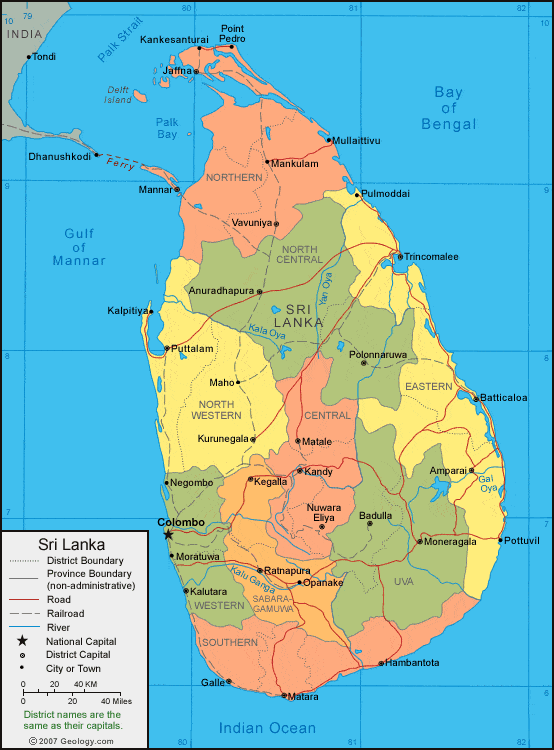
The A/C buses are the obvious first choice in any trip, but they only run on the most popular routes. We were told that A/C buses run directly from Galle (where I'm located) to Nuwara Eliya (our final destination in the center of the island, see map).
Upon arriving at the Galle bus station, we were told that there are in fact no direct routes from Galle to Nuwara Eliya (the bus station is choatic, so it's hard to tell if people properly understand your question or are just lying). So instead we hopped on an A/C bus to Colombo (the capital) in hopes of transferring to a Nuwara Eliya bus there. About 20km outside of Colombo, all buses have to pull over to one or more checkpoints. Everyone gets off the bus and Armed Guards search through everyone's bag (unless you're white, then you just get waved through). The bus then drives up onto ramps and the bottom is inspected for bombs. This happens to EVERY SINGLE BUS entering the capital. It is a bit comforting to see the thoroughness of their terrorist prevention, but still chilling to know why it is a necessity. I was going to snap some pictures, but the Army gets agitated when you take pictures of "sensitive" things.
We arrived in Colombo unscathed and proceeded to find another A/C bus to Nuwara Eliya... What's that? They only leave in the morning? Damn... It was now 5pm and we were unsure how we were getting from Colombo to Nuwara Eliya. Feeling even more daring, we decided to get on a non-A/C private bus. The bus had 5 small seats in each row, 30+ rows and barely enough leg room for me to fit (much less for the 6'0"+ volunteers). The bus was hot, smelt funny and below my seat was an unaccompanied duffel bag. I kindly leaned over and asked a Sri Lankan how long this trip would take. 7 HOURS!!! The whole situation didn't add up, so we unanimously agreed to get off before departure.
We instead hopped on an A/C bus and took it an hour north to the beach town of Negumbo. Spent the night in a run-down beach front hotel and managed to find the local drinking hole (called the Rodeo Bar... no idea why, they had no mechanical bull). After leaving the bar, we managed to find a Tuk Tuk (3-wheeler) driver nice enough to allow us to drive. It's amazing what you can do with $5.00 in this country.
Still determined to make it to Nuwara Eliya, we hired a van to drive us. We arrived in Nuwara Eliya 4 hours later after being pulled over once (the driver got ticketed and had to make a detour to the nearest police station). We stopped off at a hotel on the way which was set on a hill side over looking the Rambodha waterfall. It was a buffet lunch, the food and views were amazing.
It was a short drive from the the waterfalls to Nuwara Eliya and we arrived around 4pm. The city is nick named "Little Britain" because the climate is very similar to that of Britain. It was cool and damp, a nice change from the sweltering heat of the coast. It was really weird to see Sri Lankans walking around in jackets and pants, while our group was still in shorts and T-shirts.
We stayed one night in a small hotel and woke up around 4am to make it to World's End before 10am (the fog rolls in and blocks the view by midday). Getting to the trail head took 2 hours up a long a windy road. We finally reached the starting point and were greeted by this little fella:
World's End is the edge of a large national park known as Horton's Plain. It is a flat area (as most plains are) high above the rest of the island. On the south western edge of the park, the plains abruptly end and drop off vertically for over 1000m. The actual hike is quite easy since you start at the highest point and walk along a flat path. We hiked through some dense vegetation and which finally opened up to "World's End." The views were great and we got really lucky with the weather as it was cloudy in Nuwara Eliya that morning. Here are some shots from the hike including one waterfall we saw on the way.
After the hike we met back up with our van and began the long drive back to Galle. The road we took travels right through the Hill Country which is the epicenter for tea production in Sri Lanka. All the hill (literally) were covered in Tea bushes. We stopped off at one factory and got a brief tour and a free cup of Ceylon's finest. I took short videos of the factory, but since my laptop is broken I have no way of putting them together. Enjoy the pictures in the mean time.
Tuesday, July 8, 2008
For the next couple posts, I’ll try to write a little about Bali/Lombok and a little about my current stay in Sri Lanka.
We flew from Jogjakarta (Java) to Denpasar (Bali) instead of taking a train and then a ferry.It was not much more in terms of money, but did save us a load of time.The airport is known as DenpasarInternationalAirport which is named after the capital, but in actuality the airport is south of the capital and much closer to KutaBeach, where we spent our first night.Kuta is a complete tourist destination and reminds me A LOT of Cancun / Cabo San Lucus / Tijuana and every other spring break location rolled into one.It is really popular with the young crowd and tends to be a hot spot for Australians on school break.I thought it was quite over developed and polluted.On the bright side, it does have a huge beach with great waves for learning how to surf.We decided to take it easy and just found a beach front bar for a few drinks.We went back to our hotel soon after and went to sleep.The next day we were planning on heading to the much less touristy north coast.
Quick note:Tourism in Indonesia was really down when we went.Typically this time of the year is the beginning of the peak season, but because of the Euro Cup (second largest soccer tournament in the world) most Europeans decided to stay at home for the month of June.Add that to the lingering fear of further club bombings for a few years ago and the results were vacancies at all hotels, no lines for any restaurants (half were completely empty) and a less crowded feeling to the whole experience.Even with this, the island is still swarming with westerners.
In the morning we decided the best way to get from one side of the island to the other was to rent a car and drive.We rented a Toyota Kijang (A what? Yeah… exactly) which is the size of a midrange SUV, but packs the punch of a Honda Civic.It was perfect for our leisurely drive through a tropical island.
Navigating the Kijang
Between all of us we had zero years combined of overseas, drive on the left side of the road experience.So naturally we figured it would be a piece of cake.This wasn’t the case.Roads in Bali are EXTREMELY narrow, often barely wide enough for two cars and the lines are suggestions rather than limitations.The only freeways are directly around the capital, but once you venture 10-15 miles out all the roads look the same.The streets have absolutely no signs and the only way to orient yourself are with signs indicating the direction of major towns (no distances are given).Often we would have to read the addresses of places to see which town we were in and match it up our rickety map.To make matters worst, most Indonesians zip around on scooters and will weave in and out of cars with no fear.You literally have to force your way through intersections since traffic lights are either no existent or completely ignored.It was a bit harrowing at times, but we saw a lot of the island and having the freedom to stop whenever is something you don’t get on a tourist bus.
Half way through we stopped a temple on lakeBratan.It was a complete coincidence, but this temple is one of the most photographed landmarks in Bali and commonly found on postcards.
Bratan Temple
The temples main attraction is a bit which floats separately in the lake and presumably is accessible by boat only.We snapped a few pictures and continued onward.
Waterfall on the way to Lovina
We arrived in a small town known as Lovina, which Lonely Planet touts as the perfect place to go to do absolutely nothing.It has black sand beaches and the water is completely calm.Without knowing otherwise you would think the town was lakefront, not oceanfront.We found a small hotel on the beach and coughed up the $10.00 per person for a night.Our bungalow was beachfront with an open air bathroom… quite nice if I say so myself.
The actual town of Lovina has a really nice “small beach town” feeling to it.None of the buildings are more than 2 stories and it’s full of little Inns, local open air restaurants and bars.Lovina is also a major fishing town so all the restaurants advertise different fresh fish caught each day.I became quite fond of a local dish known as Serrapah which is fried calamari with a curry sauce served over rice.Delicious…
We also signed up for a snorkeling trip to a small island an hour away.The package also included a sunrise boat ride and to see dolphins just off the coast in front of the town.I was presuming the dolphin watching would be a small private viewing with a few other people, especially cons
idering the severe lack of tourists.I was completely wrong… The dolphin watching is more accurately described as a dolphin rodeo.We ventured out on essentially a motorized canoe for about 45 minute.We were one of the first boats out but were soon surrounded by dozens of similar rigs, each containing 4 or 5 tourists with cameras in hand.No one really know where the dolphins will surface or if they will even surface at all.For the most part each boat putters in circles as the captain keeps look out.Everything is rather calm… until… A DOLPHIN! It surfaced 100m away.Pandamonium breaks loose as every boat (some 50 by this point) smashes on the throttle and rips towards the school of animals.Before we even get there the group has submerged again and is invisible to us.This process of wait…. spot… sprint… miss… continues for an hour until the captain gives up and drives back to the mainland.The whole production is much more entertaining
than the actual dolphins.
No where near Kansas anymore…
I’ve been in Sri Lanka now for 3 days and it’s has been a real eye opening experience.The first day and night was spent in Colombo, the capital of Sri Lanka.I was really exhausted after spending two nights sleeping on pushed together benches in over air conditioned airports.Actuall
y, my night in Chennai, India deserves a quick story.I arrived in Chennai at midnight and had a 7 hour lay over until my flight out to Sri Lanka.You can not receive a visa on arrival and I never bothered to apply for one in advance (who wants to see India for the first time between midnight and 7 am?).I got off the plan and was escorted by an airport employee to the transit area where I was allowed to wait until my next flight.I was unable to pick up my ticket for the second leg of the trip in Singapore so the woman told me she would pick up the ticket and return it to me at 4:00am.
How I spent 7 hours
I gave her my only copy of the flight confirmation and found a large room which was full of cushioned benches.The room had so many that I could not tell if it was a storage area or a proper waiting room… I pushed two of them close together and tried to fall asleep.I had made the m
istake of wearing shorts and a t-shirt since outside of the airports was a sweltering 90 degree.Unfortunately, inside the airport was 40 degrees (or so it felt) and I was freezing.I fell in and out of sleep for two hours in the fetal position, not to mention I was the only person in a room which could seat hundreds.I was awaken by the poke of something at around 3am.I opened my eyes and sprung up in complete confusion.Standing in front of me were two Indian army officers… semi automatic rifles in hand.
“Can I see boarding pass sir?” One of them said in broken English.
“Uhh… umm… , sure, let me… um… find it,” I responded.
I opened my backpack, but I so disoriented from lack of sleep tha
t I could not remember what I was looking for.I pulled out my passport and held it out.Without grabbing he looked at it and looked back at me.
“Your boarding pass, sir”
“Oh right”
By this time I was coming to my senses.
“I actually don’t have one right now, a young lady who works here is picking it up for me.” I said
“Can I see confirmation then sir?”He replied.
Then it hit me…The lady had my only copy of my confirmation. I had no documents to prove I was leaving India, nor did I have a visa to legally allow me to stay in India.Quite a pickle…
“I don’t have a confirmation either, the woman who is picking up my boarding pass took it.”
“When is your flight?”
“At 7:30am”
And they walked off…
Oddly, I wasn’t able to fall back asleep.I sat there awake, read my L
onely Planet, Sri Lanka book and waited for the lady to r
eturn with my boarding pass.4:00am came and passed… then 5:00am, 6:00am and 7:00am, all without any sign of my boarding pass.I was getting a little flustered and started seconding guessing myself.Did she really work for the airport?What was taking her so long?I began to work on a Sodoku to take my mind off of it.It was ranked ‘Easy,’ but due to my lack of coherence still took me the better part of half an hour.7:20am and a young lady taps me on my shoulder.She has a boarding pass in hand and gives it to me.I smile politely, and breathe a sigh of relief.I walk through security and board a half full flight.I am the only westerner on the entire plane…
My entry card:
My first evening and night in Colombo were quite uneventful.I was taken out to dinner by one of the staff members and went back to my hotel room for a nice long sleep.The next morning I woke up and was picked up at 6:00am to be take 100km south to Galle. On the way we passed by a recent train accident:
Apparently the train derailed (non-terrorist related) and I believe 6 people died. It was really eerie to see and not a pleasant way to be welcomed into a country. It has also made me think twice about riding the public transportation here. We soon after entered the town of Galle.
Beautiful Galle
This is the town I would be living in for the next two months. Its main claim to fame is a 16th century dutch fort built during the time of dutch occupation. It has massive walls (40 - 50 feet high) and has held up over time. I haven't actually been to the fort yet, but it's inevitable.
Today was my first really day in the hospital.I had a small orientation yesterday which consisted of a nurse taking me around all the areas of the hospital.The place is HUGE… with 52 wards, I quickly became lost.It is also a teaching hospital and therefore is full of student nurses and a handful of student doctors.Each new ward introduction went something like this.
“This… neurology.You want see inside?”
“Sure… I’ll have a look.”
We would walk in and usually there would be a doctor at a central table.For the most part the doctors speak fairly good English, while the nurses speak very minimal English (or Singlish as I call it, a mix of Sinhala and English).The nurse would then ask.
“Would you like speak to patient?”
“Absolutely, Why not?”
This happened a half dozen times and every time it would consist of me introducing myself to a bed ridden Sri Lankan who spoke ZERO English.I would shake their hand, and we would exchange head nods and smiles for 30 seconds or so.During this time, a group of 10 – 20 student nurses would gather behind me and watch.I’m not sure where they would come from, but inevitably they would appear.No one would be speaking… Just smiles…. And head nods… Yeah… It was really awkward.
Today was a lot different.I was assigned to the Mini Operation Department which is a tiny operating room for outpatients.Essentially all minor surgeries which don’t result in hospitalization happen here.Within the first couple hours I saw five ingrown toe nail removals, 4 cyst removals and countless venous ulcer (I think that’s what they call it) cleanings.The method of treatment is worlds different than in America.The patient comes in and lies down immediately.The doctor injects lidocaine (numbing agent) and epinephrine (to prevent excessive bleeding).He then instantly goes to work… I doubt the anesthetic has even set in.Within 10 minutes, he will have sliced, cut, cleaned and sewed.The patient leaves and another one comes in within seconds.The paper work is minimal, which makes the turnover incredibly fast.The process repeats… The doctors has a Bluetooth headset which rings every 30 minutes or so and he always answers it while working.He’s quite the multi-tasker.
The mini operating room
Here is the second story of the house I am living in, my room is just through that door on the left. Everything is open air...
Before I get into a handful of blog posts ranting and raving about Bali and Lombok, I thought I would let everyone know that I have arrived in Sri Lanka. The voyage was looooooooooong... and tiring. I arrived in Sri Lanka at 9:00am on July 1st after having traveled for nearly two days (I left my last hotel room at 6:30am on June 29th). It took a taxi, public ferry, private bus and three flights to get to Colombo, Sri Lanka from Sengigi, Lombok. I had a 20 hour layover in Singapore and an 8 hour layover in Chennai, India... but I've finally arrived.
I am in a hotel in Colombo (the capital) for the first night. It is included in the program I signed up for and is allowing me to get some proper sleep. I just got done with dinner with a very friendly woman named Emilia who will be my primary contact while in Sri Lanka and she went over the details of my placement. I will be living in Galle, Sri Lanka which is a town of approximately 90,000 and is located on the south western tip of the island. The town's main attractions are the 16th century dutch fort and picturesque beaches. I will be working at Karapitiya Teaching Hospital with two other volunteers (both are guys from England). The hospital is quite large with a staff including over 400 doctors. It is also the primary hospital for Sri Lankan medical students to do their internships and rotations at. I'm sure you'll be sick of hearing about the hospital over the next few weeks... so i'll leave it at that.
Emilia pulled out a map and gave me a quick rundown on the current political situation. Sri Lanka is a small country (about the size of Ireland), but got a lot smaller after she indicated areas which are not advisable to visit. Unless you only watch Fox News, you should probably have some idea of the current situation in Sri Lanka. The northern region is occupied by the Tamil, who are decedents of southern India and predominately Hindu. They make up about 18% of the population of Sri Lanka. The rest of the island is populated by the Sinhalese who are predominantly Buddhist. The conflict doesn't stem from a difference of religion, but rather the Sinhalese government disenfranchising the Tamil. The history of it is a bit long and confusing (see wikipedia...), but essentially the Tamil want an independent region of Sri Lanka. A small subpopulation of the Tamil known as the Tamil Tigers have been fighting the Sri Lankan army for over two decades towards this goal. Recently the violence between the two groups has increased as the Tamils have moved from military style attacks to terrorist attacks... predominately in Colombo. Security has been increased dramatically in the capital to prevent future attacks. Nearly every bridge, government building and major intersection has a few military officers with semi-automatic rifles in hand. Roads are continually being closed and opened again for high ranking government officials to move around the city. It's all a bit unnerving.
But don't me paint a completely hopeless picture. Despite the always looming threat of an attack, the capital is still a bustling mecca center. Markets are packed full of people, the streets of full of traffic and temples are full of worshipers. The city has a palpable energy and is a fascinating place. I took a tuk tuk around (three wheel glorified golf cart) and went through Pettah market (Colombo's most crowded street market) and to a Buddhist temple. The people are very friendly and full of smiles... it's a quite a paradox from the news reports.
I off to bed now, I have to wake up at 5:00am tomorrow to head down the coast (don't worry, in a private car) to arrive in Galle by 9:00am. We are stopping at a small town on the way for breakfast. I can't wait to see what rural Sri Lanka looks like. The area we will be traveling through was hit hardest by the 2004 tsunami and the damage is apparently still very noticeable.