For my final weekend in Sri Lanka I planned a trip to one of Sri Lanka's most interesting places, Adam's Peak (also known as Sri Pada). It is the fifth highest peak in Sri Lanka and home to a mountain of religious myths. On the top of the mountain sits a bizarre impression which resembles a foot print. Depending on which religion you ask, the story behind the foot print changes.
Buddhism - Buddha left the print
Islam - After Adam was cast out of Eden, he landed upon this mountain and stood on one foot until his sins were forgiven.
Catholism - St. Thomas left the print
Hinduism - Siva left the print
Although the peak has sparked the interest of many religions, the mountain is predominantly a Buddhist pilgrimage site. This is apparent from the numerous Buddha statues and pagodas at the base of the trek. The "best" season for hiking to the top is between December and May when the weather is drier. During full moons which fall in these months, it is not uncommon for thousands of pilgrims to ascend in one day. Besides the weather, the benefits of climbing in the right season include lights the entire way up the mountain and tea shops along the trail open all night.
Unfortunately for Jack and myself, we climbed the peak in August... right smack in the off season. I had had countless warnings about heavy rainfall and "jungle animals" preventing adventurous westerners from climbing off season, but I was determined to do it anyway.
Getting to the base of the mountain was an adventure in itself. I first has to take a bus from Galle (in the south) to the capital of Colombo (on the west coast). From there, Jack and I hopped on a train. We had the intention of purchasing 1st class tickets as recommended by Lonely Planet and Rough Guide, but these were sold out due to school holidays. We settled for second class tickets (third class does exist and it resembles a cattle car). The tickets for second class do not guarantee you a seat (news to us) and we ended up spending the entire journey in the passageway between two cars... hanging out the train from time to time. The railway system is INCREDIBLY rickety. The trains literally bounce along the track and it feels asthough they are going to fly off at any moment. We traveled through some of the poorest neighborhoods of the country and saw some incredible views along the way.
We arrved in Hatton, a small town in the hill country and took a bus to Maskeliya... a smaller town in the hill country. From here we had to catch another bus to Dalhousie... the smallest town in the hill country (not really, but it seemed like it). Dalhousie is home to many tea pickers and due to its proximity to Sri Pada, has a handful of hotels and guesthouses. We stayed at a lovely place called River View Inn for much less than the advertised price (the perks of traveling in the off season).
I had left my house at 5am to begin the journey to Galle and we arrived in Dalhousie at 8pm (ahh the efficiency of third world public transportation). At the time we arrived, it was raining quite heavily. We were planning on starting the hike at 2am in order to see the sunrise from the summit... rain or shine.
Sunday, August 31, 2008

Sunday, August 17, 2008
Kandy Esala Perahera
I just arrived back in Galle from spending a weekend in Kandy (Sri Lanka's second largest city). Besides being an enormous town situated in the Hill Country, the city is also home to Sri Lanka's most important Buddhist relic... A tooth from Lord Buddha himself. The legend tells of Arahat Khema (one of two female disciples of Buddha) grabbing the tooth from Buddha's cremation in the 4th century BCE. The tooth then past between hand for hundreds of years until eventually a princess smuggled it into Sri Lanka. It moved around Sri Lanka quite a bit, changes hands of various kings. Finally a temple was constructed (the temple of the sacred tooth relic) and the tooth was placed inside.
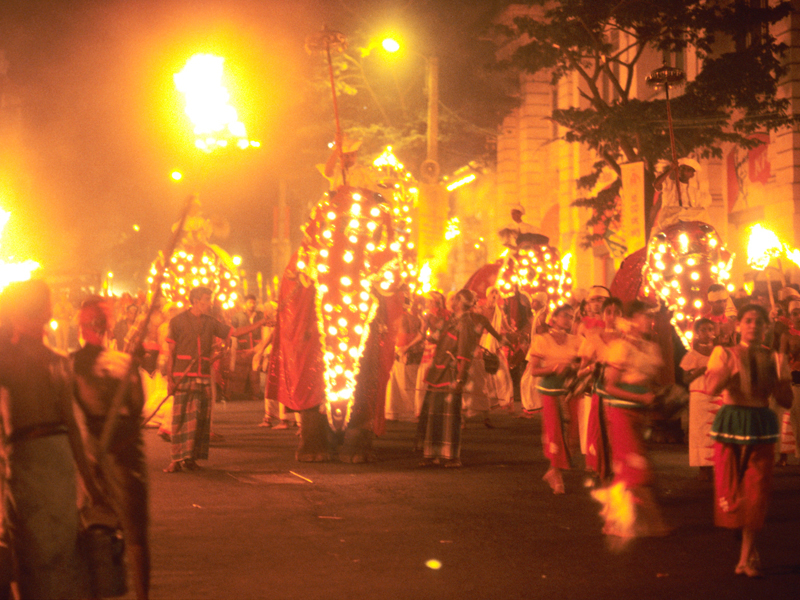
This weekend was a unique experience as it was the Esala Perahera. This is Sri Lanka's (and one of Buddhisms) largest festivals in which the tooth relic leaves the temple (one night a year) and is paraded down the main street in a massive ceremony. The festival is actually 10 days long, but the final night is the largest and the only night in which the tooth is paraded around (technically... the tooth is never seen, only the gold casket containing the tooth).
Thousands of devote Buddhists flock to the streets to try and gain a glimpse of the procession. Free spots on the sidewalks are occupied 12 hours before the procession starts and reserved seats can be purchased for around $25.00 (which is what most tourist do). The procession starts at 8pm and last for 3 hours. The entire time there is steady stream of whip crackers, fire twirlers, elephants, drummers and dancers. Thousands of people participate, but the highlight of the festival is the elephant carrying the tooth relic.
Here is shot of what the procession generally looked like:

Here is the tooth relic (stupa containg it...) - taken from Wikipedia

We spent the rest of the weekend walking around Kandy. I visited the sacred tooth relic temple which was quite impressive. The building is a World Heritage Site and fell victim to a Tamil Tiger bombing in 1988. The scars from which have been completely repaired, but the museum in the temple had some graphic images of the event.
Temple of the Sacred Tooth Relic

Jack and I outside the temple... just blending in with the locals

Elephant high-five

On Sunday, we stopped off the the Pinnawella Elephant Orphanage. It is a government funded organization for abandoned elephants and has turned into one of the biggest tourist attractions on the island. At the time we arrived, the elephants were being taken to a nearby river to bathe.


The elephants are all extremely obedient and harmless. They splash around in the water and then walk over to the tourists, give them a good sniff and head back to the water. Afterwards, the elephants are herded back to the orphanage (see video).
This weekend was a unique experience as it was the Esala Perahera. This is Sri Lanka's (and one of Buddhisms) largest festivals in which the tooth relic leaves the temple (one night a year) and is paraded down the main street in a massive ceremony. The festival is actually 10 days long, but the final night is the largest and the only night in which the tooth is paraded around (technically... the tooth is never seen, only the gold casket containing the tooth).
Thousands of devote Buddhists flock to the streets to try and gain a glimpse of the procession. Free spots on the sidewalks are occupied 12 hours before the procession starts and reserved seats can be purchased for around $25.00 (which is what most tourist do). The procession starts at 8pm and last for 3 hours. The entire time there is steady stream of whip crackers, fire twirlers, elephants, drummers and dancers. Thousands of people participate, but the highlight of the festival is the elephant carrying the tooth relic.
Here is shot of what the procession generally looked like:
Here is the tooth relic (stupa containg it...) - taken from Wikipedia

We spent the rest of the weekend walking around Kandy. I visited the sacred tooth relic temple which was quite impressive. The building is a World Heritage Site and fell victim to a Tamil Tiger bombing in 1988. The scars from which have been completely repaired, but the museum in the temple had some graphic images of the event.
Temple of the Sacred Tooth Relic

Jack and I outside the temple... just blending in with the locals

Elephant high-five

On Sunday, we stopped off the the Pinnawella Elephant Orphanage. It is a government funded organization for abandoned elephants and has turned into one of the biggest tourist attractions on the island. At the time we arrived, the elephants were being taken to a nearby river to bathe.


The elephants are all extremely obedient and harmless. They splash around in the water and then walk over to the tourists, give them a good sniff and head back to the water. Afterwards, the elephants are herded back to the orphanage (see video).
Wednesday, August 13, 2008
David vs. Goliath
Forget Arnold Palmer vs. Jack Nicklaus, forget North Carolina vs. Duke and forget Muhammad Ali vs. Joe Frazier. These rivalries don't match up to arguably the world's greatest battle... yes that's right, I'm talking about India vs. Sri Lanka in a 3-day Cricket test match. In case you are not familiar with the game of cricket, take a moment to ponder over this page:
http://en.wikipedia.org/wiki/Cricket
The sport has many similarities to American baseball. A hitter is trying to hit a ball and score runs. The pitcher (called a bowler) is trying to hit the wooden pegs directly behind the batter and therefore get him out. If the batter hits the ball in the air and it is caught by a fielder, he is out. Each match lasts 4 days and in this case there were 3 matches. So technically, one game last 12 days.... yah... it's white knuckle. Each match was played in a different Sri Lankan city with one match being in Galle (where I am located).
The Galle International Cricket Stadium is located directly in front of a 16th century dutch fort and right next to the ocean. The scenery is breath taking and before the tsunami, this was considered one of the most picturesque stadiums in Asia. Unfortunately the tsunami came and wiped out the stadium. Due to lack of funds, the replacement stadium seats far less spectators than the original, but still packs the same breath taking scenery.
Here is a view of the stadium from the wall of the Fort:

I went to two of the four days for which the match was being played in Galle. On the first day, I went with a group of other volunteers and we sat in the upper part of the left set of seats (in reference to the above photo). The tickets were some of the more expensive ones at 300 rupees ($3.00).
Here is a picture from the seats, facing the fort:

On the second day, I went with my host family. The father happens to know the owner of the stadium and we sat in an over air conditioned suite located on the right side of the central building. They served us tea and snacks, but i was freezing the entire time. The game itself is really boring, but worth the experience.
Some sweet action shots:


And one last one of me with Abadu (Ab-ah-do), my host father's son.

http://en.wikipedia.org/wiki/Cricket
The sport has many similarities to American baseball. A hitter is trying to hit a ball and score runs. The pitcher (called a bowler) is trying to hit the wooden pegs directly behind the batter and therefore get him out. If the batter hits the ball in the air and it is caught by a fielder, he is out. Each match lasts 4 days and in this case there were 3 matches. So technically, one game last 12 days.... yah... it's white knuckle. Each match was played in a different Sri Lankan city with one match being in Galle (where I am located).
The Galle International Cricket Stadium is located directly in front of a 16th century dutch fort and right next to the ocean. The scenery is breath taking and before the tsunami, this was considered one of the most picturesque stadiums in Asia. Unfortunately the tsunami came and wiped out the stadium. Due to lack of funds, the replacement stadium seats far less spectators than the original, but still packs the same breath taking scenery.
Here is a view of the stadium from the wall of the Fort:

I went to two of the four days for which the match was being played in Galle. On the first day, I went with a group of other volunteers and we sat in the upper part of the left set of seats (in reference to the above photo). The tickets were some of the more expensive ones at 300 rupees ($3.00).
Here is a picture from the seats, facing the fort:

On the second day, I went with my host family. The father happens to know the owner of the stadium and we sat in an over air conditioned suite located on the right side of the central building. They served us tea and snacks, but i was freezing the entire time. The game itself is really boring, but worth the experience.
Some sweet action shots:


And one last one of me with Abadu (Ab-ah-do), my host father's son.

Thursday, July 31, 2008
To the end of the world
As if this blog hasn't been disappointing enough, my laptop has recently "hit the fan" and all my backed up pictures are saved on it. So as of now I only have access to pictures of more recent events which are still on my memory card. In any case, I'll talk about a recent little excursion.
Recently, a couple of the volunteers and I took a trip to the Hill Country to visit some tea plantations and hike to a spot known as World's End. We were feeling adventurous and decided to take public transportation instead of hiring a private van. The price to ride public transportation is about 40 fold cheaper than hiring a van, but you run the risk of hopping on a bus with a suicide bomber... pros and cons. There are essentially three categories of buses:
I.Government run non-A/C buses (dirt cheap, but are most likely to be targeted)
II.Private non-A/C buses (same bus as government, but painted differently. Also dirt cheap but dangerous)
III.A/C buses (A bit more expensive, but still dirt cheap by western standards and relatively safe. They are about half the size of regular buses)
Example - The red one is a government bus, the white ones are private:

The A/C buses are the obvious first choice in any trip, but they only run on the most popular routes. We were told that A/C buses run directly from Galle (where I'm located) to Nuwara Eliya (our final destination in the center of the island, see map).

Upon arriving at the Galle bus station, we were told that there are in fact no direct routes from Galle to Nuwara Eliya (the bus station is choatic, so it's hard to tell if people properly understand your question or are just lying). So instead we hopped on an A/C bus to Colombo (the capital) in hopes of transferring to a Nuwara Eliya bus there. About 20km outside of Colombo, all buses have to pull over to one or more checkpoints. Everyone gets off the bus and Armed Guards search through everyone's bag (unless you're white, then you just get waved through). The bus then drives up onto ramps and the bottom is inspected for bombs. This happens to EVERY SINGLE BUS entering the capital. It is a bit comforting to see the thoroughness of their terrorist prevention, but still chilling to know why it is a necessity. I was going to snap some pictures, but the Army gets agitated when you take pictures of "sensitive" things.
We arrived in Colombo unscathed and proceeded to find another A/C bus to Nuwara Eliya... What's that? They only leave in the morning? Damn... It was now 5pm and we were unsure how we were getting from Colombo to Nuwara Eliya. Feeling even more daring, we decided to get on a non-A/C private bus. The bus had 5 small seats in each row, 30+ rows and barely enough leg room for me to fit (much less for the 6'0"+ volunteers). The bus was hot, smelt funny and below my seat was an unaccompanied duffel bag. I kindly leaned over and asked a Sri Lankan how long this trip would take. 7 HOURS!!! The whole situation didn't add up, so we unanimously agreed to get off before departure.
We instead hopped on an A/C bus and took it an hour north to the beach town of Negumbo. Spent the night in a run-down beach front hotel and managed to find the local drinking hole (called the Rodeo Bar... no idea why, they had no mechanical bull). After leaving the bar, we managed to find a Tuk Tuk (3-wheeler) driver nice enough to allow us to drive. It's amazing what you can do with $5.00 in this country.

Still determined to make it to Nuwara Eliya, we hired a van to drive us. We arrived in Nuwara Eliya 4 hours later after being pulled over once (the driver got ticketed and had to make a detour to the nearest police station). We stopped off at a hotel on the way which was set on a hill side over looking the Rambodha waterfall. It was a buffet lunch, the food and views were amazing.


It was a short drive from the the waterfalls to Nuwara Eliya and we arrived around 4pm. The city is nick named "Little Britain" because the climate is very similar to that of Britain. It was cool and damp, a nice change from the sweltering heat of the coast. It was really weird to see Sri Lankans walking around in jackets and pants, while our group was still in shorts and T-shirts.

We stayed one night in a small hotel and woke up around 4am to make it to World's End before 10am (the fog rolls in and blocks the view by midday). Getting to the trail head took 2 hours up a long a windy road. We finally reached the starting point and were greeted by this little fella:

World's End is the edge of a large national park known as Horton's Plain. It is a flat area (as most plains are) high above the rest of the island. On the south western edge of the park, the plains abruptly end and drop off vertically for over 1000m. The actual hike is quite easy since you start at the highest point and walk along a flat path. We hiked through some dense vegetation and which finally opened up to "World's End." The views were great and we got really lucky with the weather as it was cloudy in Nuwara Eliya that morning. Here are some shots from the hike including one waterfall we saw on the way.


After the hike we met back up with our van and began the long drive back to Galle. The road we took travels right through the Hill Country which is the epicenter for tea production in Sri Lanka. All the hill (literally) were covered in Tea bushes. We stopped off at one factory and got a brief tour and a free cup of Ceylon's finest. I took short videos of the factory, but since my laptop is broken I have no way of putting them together. Enjoy the pictures in the mean time.


Recently, a couple of the volunteers and I took a trip to the Hill Country to visit some tea plantations and hike to a spot known as World's End. We were feeling adventurous and decided to take public transportation instead of hiring a private van. The price to ride public transportation is about 40 fold cheaper than hiring a van, but you run the risk of hopping on a bus with a suicide bomber... pros and cons. There are essentially three categories of buses:
I.Government run non-A/C buses (dirt cheap, but are most likely to be targeted)
II.Private non-A/C buses (same bus as government, but painted differently. Also dirt cheap but dangerous)
III.A/C buses (A bit more expensive, but still dirt cheap by western standards and relatively safe. They are about half the size of regular buses)
Example - The red one is a government bus, the white ones are private:

The A/C buses are the obvious first choice in any trip, but they only run on the most popular routes. We were told that A/C buses run directly from Galle (where I'm located) to Nuwara Eliya (our final destination in the center of the island, see map).
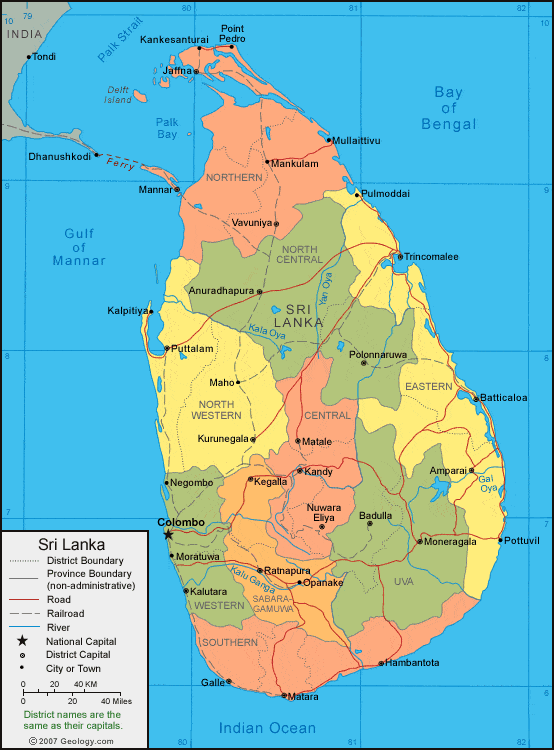
Upon arriving at the Galle bus station, we were told that there are in fact no direct routes from Galle to Nuwara Eliya (the bus station is choatic, so it's hard to tell if people properly understand your question or are just lying). So instead we hopped on an A/C bus to Colombo (the capital) in hopes of transferring to a Nuwara Eliya bus there. About 20km outside of Colombo, all buses have to pull over to one or more checkpoints. Everyone gets off the bus and Armed Guards search through everyone's bag (unless you're white, then you just get waved through). The bus then drives up onto ramps and the bottom is inspected for bombs. This happens to EVERY SINGLE BUS entering the capital. It is a bit comforting to see the thoroughness of their terrorist prevention, but still chilling to know why it is a necessity. I was going to snap some pictures, but the Army gets agitated when you take pictures of "sensitive" things.
We arrived in Colombo unscathed and proceeded to find another A/C bus to Nuwara Eliya... What's that? They only leave in the morning? Damn... It was now 5pm and we were unsure how we were getting from Colombo to Nuwara Eliya. Feeling even more daring, we decided to get on a non-A/C private bus. The bus had 5 small seats in each row, 30+ rows and barely enough leg room for me to fit (much less for the 6'0"+ volunteers). The bus was hot, smelt funny and below my seat was an unaccompanied duffel bag. I kindly leaned over and asked a Sri Lankan how long this trip would take. 7 HOURS!!! The whole situation didn't add up, so we unanimously agreed to get off before departure.
We instead hopped on an A/C bus and took it an hour north to the beach town of Negumbo. Spent the night in a run-down beach front hotel and managed to find the local drinking hole (called the Rodeo Bar... no idea why, they had no mechanical bull). After leaving the bar, we managed to find a Tuk Tuk (3-wheeler) driver nice enough to allow us to drive. It's amazing what you can do with $5.00 in this country.

Still determined to make it to Nuwara Eliya, we hired a van to drive us. We arrived in Nuwara Eliya 4 hours later after being pulled over once (the driver got ticketed and had to make a detour to the nearest police station). We stopped off at a hotel on the way which was set on a hill side over looking the Rambodha waterfall. It was a buffet lunch, the food and views were amazing.


It was a short drive from the the waterfalls to Nuwara Eliya and we arrived around 4pm. The city is nick named "Little Britain" because the climate is very similar to that of Britain. It was cool and damp, a nice change from the sweltering heat of the coast. It was really weird to see Sri Lankans walking around in jackets and pants, while our group was still in shorts and T-shirts.

We stayed one night in a small hotel and woke up around 4am to make it to World's End before 10am (the fog rolls in and blocks the view by midday). Getting to the trail head took 2 hours up a long a windy road. We finally reached the starting point and were greeted by this little fella:

World's End is the edge of a large national park known as Horton's Plain. It is a flat area (as most plains are) high above the rest of the island. On the south western edge of the park, the plains abruptly end and drop off vertically for over 1000m. The actual hike is quite easy since you start at the highest point and walk along a flat path. We hiked through some dense vegetation and which finally opened up to "World's End." The views were great and we got really lucky with the weather as it was cloudy in Nuwara Eliya that morning. Here are some shots from the hike including one waterfall we saw on the way.


After the hike we met back up with our van and began the long drive back to Galle. The road we took travels right through the Hill Country which is the epicenter for tea production in Sri Lanka. All the hill (literally) were covered in Tea bushes. We stopped off at one factory and got a brief tour and a free cup of Ceylon's finest. I took short videos of the factory, but since my laptop is broken I have no way of putting them together. Enjoy the pictures in the mean time.


Tuesday, July 8, 2008
We flew from
Quick note: Tourism in
In the morning we decided the best way to get from one side of the island to the other was to rent a car and drive. We rented a Toyota Kijang (A what? Yeah… exactly) which is the size of a midrange SUV, but packs the punch of a Honda Civic. It was perfect for our leisurely drive through a tropical island.
Navigating the Kijang

Between all of us we had zero years combined of overseas, drive on the left side of the road experience. So naturally we figured it would be a piece of cake. This wasn’t the case. Roads in
Half way through we stopped a temple on
Bratan Temple

The temples main attraction is a bit which floats separately in the lake and presumably is accessible by boat only. We snapped a few pictures and continued onward.
Waterfall on the way to Lovina

We arrived in a small town known as Lovina, which Lonely Planet touts as the perfect place to go to do absolutely nothing. It has black sand beaches and the water is completely calm. Without knowing otherwise you would think the town was lakefront, not oceanfront. We found a small hotel on the beach and coughed up the $10.00 per person for a night. Our bungalow was beachfront with an open air bathroom… quite nice if I say so myself.
The actual town of
We also signed up for a snorkeling trip to a small island an hour away. The package also included a sunrise boat ride and to see dolphins just off the coast in front of the town. I was presuming the dolphin watching would be a small private viewing with a few other people, especially cons
idering the severe lack of tourists. I was completely wrong… The dolphin watching is more accurately described as a dolphin rodeo. We ventured out on essentially a motorized canoe for about 45 minute. We were one of the first boats out but were soon surrounded by dozens of similar rigs, each containing 4 or 5 tourists with cameras in hand. No one really know where the dolphins will surface or if they will even surface at all. For the most part each boat putters in circles as the captain keeps look out. Everything is rather calm… until… A DOLPHIN! It surfaced 100m away. Pandamonium breaks loose as every boat (some 50 by this point) smashes on the throttle and rips towards the school of animals. Before we even get there the group has submerged again and is invisible to us. This process of wait…. spot… sprint… miss… continues for an hour until the captain gives up and drives back to the mainland. The whole production is much more entertaining
than the actual dolphins.
No where near
I’ve been in
y, my night in
How I spent 7 hours

I gave her my only copy of the flight confirmation and found a large room which was full of cushioned benches. The room had so many that I could not tell if it was a storage area or a proper waiting room… I pushed two of them close together and tried to fall asleep. I had made the m
istake of wearing shorts and a t-shirt since outside of the airports was a sweltering 90 degree. Unfortunately, inside the airport was 40 degrees (or so it felt) and I was freezing. I fell in and out of sleep for two hours in the fetal position, not to mention I was the only person in a room which could seat hundreds. I was awaken by the poke of something at around
“Can I see boarding pass sir?” One of them said in broken English.
“Uhh… umm…
I opened my backpack, but I so disoriented from lack of sleep tha
t I could not remember what I was looking for. I pulled out my passport and held it out. Without grabbing he looked at it and looked back at me.
“Your boarding pass, sir”
“Oh right”
By this time I was coming to my senses.
“I actually don’t have one right now, a young lady who works here is picking it up for me.” I said
“Can I see confirmation then sir?” He replied.
Then it hit me… The lady had my only copy of my confirmation. I had no documents to prove I was leaving
“I don’t have a confirmation either, the woman who is picking up my boarding pass took it.”
“When is your flight?”
“At
And they walked off…
Oddly, I wasn’t able to fall back asleep. I sat there awake, read my L
onely Planet,
eturn with my boarding pass.
My entry card:

My first evening and night in

Apparently the train derailed (non-terrorist related) and I believe 6 people died. It was really eerie to see and not a pleasant way to be welcomed into a country. It has also made me think twice about riding the public transportation here. We soon after entered the town of Galle.
Beautiful Galle

This is the town I would be living in for the next two months. Its main claim to fame is a 16th century dutch fort built during the time of dutch occupation. It has massive walls (40 - 50 feet high) and has held up over time. I haven't actually been to the fort yet, but it's inevitable.
Today was my first really day in the hospital. I had a small orientation yesterday which consisted of a nurse taking me around all the areas of the hospital. The place is HUGE… with 52 wards, I quickly became lost. It is also a teaching hospital and therefore is full of student nurses and a handful of student doctors. Each new ward introduction went something like this.
“This… neurology. You want see inside?”
“Sure… I’ll have a look.”
We would walk in and usually there would be a doctor at a central table. For the most part the doctors speak fairly good English, while the nurses speak very minimal English (or Singlish as I call it, a mix of Sinhala and English). The nurse would then ask.
“Would you like speak to patient?”
“Absolutely, Why not?”
This happened a half dozen times and every time it would consist of me introducing myself to a bed ridden Sri Lankan who spoke ZERO English. I would shake their hand, and we would exchange head nods and smiles for 30 seconds or so. During this time, a group of 10 – 20 student nurses would gather behind me and watch. I’m not sure where they would come from, but inevitably they would appear. No one would be speaking… Just smiles…. And head nods… Yeah… It was really awkward.
Today was a lot different. I was assigned to the Mini Operation Department which is a tiny operating room for outpatients. Essentially all minor surgeries which don’t result in hospitalization happen here. Within the first couple hours I saw five ingrown toe nail removals, 4 cyst removals and countless venous ulcer (I think that’s what they call it) cleanings. The method of treatment is worlds different than in
The mini operating room

Here is the second story of the house I am living in, my room is just through that door on the left. Everything is open air...

Tuesday, July 1, 2008
Aayu-bowan!
Before I get into a handful of blog posts ranting and raving about Bali and Lombok, I thought I would let everyone know that I have arrived in Sri Lanka. The voyage was looooooooooong... and tiring. I arrived in Sri Lanka at 9:00am on July 1st after having traveled for nearly two days (I left my last hotel room at 6:30am on June 29th). It took a taxi, public ferry, private bus and three flights to get to Colombo, Sri Lanka from Sengigi, Lombok. I had a 20 hour layover in Singapore and an 8 hour layover in Chennai, India... but I've finally arrived.
I am in a hotel in Colombo (the capital) for the first night. It is included in the program I signed up for and is allowing me to get some proper sleep. I just got done with dinner with a very friendly woman named Emilia who will be my primary contact while in Sri Lanka and she went over the details of my placement. I will be living in Galle, Sri Lanka which is a town of approximately 90,000 and is located on the south western tip of the island. The town's main attractions are the 16th century dutch fort and picturesque beaches. I will be working at Karapitiya Teaching Hospital with two other volunteers (both are guys from England). The hospital is quite large with a staff including over 400 doctors. It is also the primary hospital for Sri Lankan medical students to do their internships and rotations at. I'm sure you'll be sick of hearing about the hospital over the next few weeks... so i'll leave it at that.
Emilia pulled out a map and gave me a quick rundown on the current political situation. Sri Lanka is a small country (about the size of Ireland), but got a lot smaller after she indicated areas which are not advisable to visit. Unless you only watch Fox News, you should probably have some idea of the current situation in Sri Lanka. The northern region is occupied by the Tamil, who are decedents of southern India and predominately Hindu. They make up about 18% of the population of Sri Lanka. The rest of the island is populated by the Sinhalese who are predominantly Buddhist. The conflict doesn't stem from a difference of religion, but rather the Sinhalese government disenfranchising the Tamil. The history of it is a bit long and confusing (see wikipedia...), but essentially the Tamil want an independent region of Sri Lanka. A small subpopulation of the Tamil known as the Tamil Tigers have been fighting the Sri Lankan army for over two decades towards this goal. Recently the violence between the two groups has increased as the Tamils have moved from military style attacks to terrorist attacks... predominately in Colombo. Security has been increased dramatically in the capital to prevent future attacks. Nearly every bridge, government building and major intersection has a few military officers with semi-automatic rifles in hand. Roads are continually being closed and opened again for high ranking government officials to move around the city. It's all a bit unnerving.
But don't me paint a completely hopeless picture. Despite the always looming threat of an attack, the capital is still a bustling mecca center. Markets are packed full of people, the streets of full of traffic and temples are full of worshipers. The city has a palpable energy and is a fascinating place. I took a tuk tuk around (three wheel glorified golf cart) and went through Pettah market (Colombo's most crowded street market) and to a Buddhist temple. The people are very friendly and full of smiles... it's a quite a paradox from the news reports.
I off to bed now, I have to wake up at 5:00am tomorrow to head down the coast (don't worry, in a private car) to arrive in Galle by 9:00am. We are stopping at a small town on the way for breakfast. I can't wait to see what rural Sri Lanka looks like. The area we will be traveling through was hit hardest by the 2004 tsunami and the damage is apparently still very noticeable.
Aayu-bowan! (Hello or Goodbye)
I am in a hotel in Colombo (the capital) for the first night. It is included in the program I signed up for and is allowing me to get some proper sleep. I just got done with dinner with a very friendly woman named Emilia who will be my primary contact while in Sri Lanka and she went over the details of my placement. I will be living in Galle, Sri Lanka which is a town of approximately 90,000 and is located on the south western tip of the island. The town's main attractions are the 16th century dutch fort and picturesque beaches. I will be working at Karapitiya Teaching Hospital with two other volunteers (both are guys from England). The hospital is quite large with a staff including over 400 doctors. It is also the primary hospital for Sri Lankan medical students to do their internships and rotations at. I'm sure you'll be sick of hearing about the hospital over the next few weeks... so i'll leave it at that.
Emilia pulled out a map and gave me a quick rundown on the current political situation. Sri Lanka is a small country (about the size of Ireland), but got a lot smaller after she indicated areas which are not advisable to visit. Unless you only watch Fox News, you should probably have some idea of the current situation in Sri Lanka. The northern region is occupied by the Tamil, who are decedents of southern India and predominately Hindu. They make up about 18% of the population of Sri Lanka. The rest of the island is populated by the Sinhalese who are predominantly Buddhist. The conflict doesn't stem from a difference of religion, but rather the Sinhalese government disenfranchising the Tamil. The history of it is a bit long and confusing (see wikipedia...), but essentially the Tamil want an independent region of Sri Lanka. A small subpopulation of the Tamil known as the Tamil Tigers have been fighting the Sri Lankan army for over two decades towards this goal. Recently the violence between the two groups has increased as the Tamils have moved from military style attacks to terrorist attacks... predominately in Colombo. Security has been increased dramatically in the capital to prevent future attacks. Nearly every bridge, government building and major intersection has a few military officers with semi-automatic rifles in hand. Roads are continually being closed and opened again for high ranking government officials to move around the city. It's all a bit unnerving.
But don't me paint a completely hopeless picture. Despite the always looming threat of an attack, the capital is still a bustling mecca center. Markets are packed full of people, the streets of full of traffic and temples are full of worshipers. The city has a palpable energy and is a fascinating place. I took a tuk tuk around (three wheel glorified golf cart) and went through Pettah market (Colombo's most crowded street market) and to a Buddhist temple. The people are very friendly and full of smiles... it's a quite a paradox from the news reports.
I off to bed now, I have to wake up at 5:00am tomorrow to head down the coast (don't worry, in a private car) to arrive in Galle by 9:00am. We are stopping at a small town on the way for breakfast. I can't wait to see what rural Sri Lanka looks like. The area we will be traveling through was hit hardest by the 2004 tsunami and the damage is apparently still very noticeable.
Aayu-bowan! (Hello or Goodbye)
Subscribe to:
Posts (Atom)